
Sábado, 6 de junho de 2026 | Porto Velho (RO)
Sábado, 6 de junho de 2026 | Porto Velho (RO)

Quarta-feira, 25 de março de 2026 - 07h35
ENGLISH VERSION BELLOW
.
Antes de adentrar a provocação de George Carlin — cuja lucidez expõe, com precisão, as contradições humanas — vale lembrar que o Brasil também teve, em Chico Anysio, um expoente do humor
inteligente.
Distintos na forma, semelhantes na essência: não faziam do humor um refúgio — mas um instrumento de revelação.
Carlin, direto e incisivo, desnudava a
linguagem e as incoerências sociais com um tom provocador.
Chico, com sutileza,
deu vida a personagens que refletiam os vícios, as ingenuidades e os paradoxos que
satirizava em suas críticas à Estado
e Sociedade.
Se um operava como bisturi, o outro
atuava como espelho.
Ambos transformaram o riso em um convite
à consciência.
Ao ouvir a provocação de George Carlin — comediante, escritor e um dos mais
contundentes críticos sociais de seu tempo — é inevitável reconhecer a força
desconcertante de sua crítica.
Carlin não era apenas um humorista. Era um
observador agudo da condição humana — alguém que utilizava o humor como instrumento
para expor contradições sociais, morais e culturais.
Ao afirmar: “The planet is fine. The people are
fucked.” ele não nega a importância
do meio ambiente —
ele denuncia a incoerência humana.
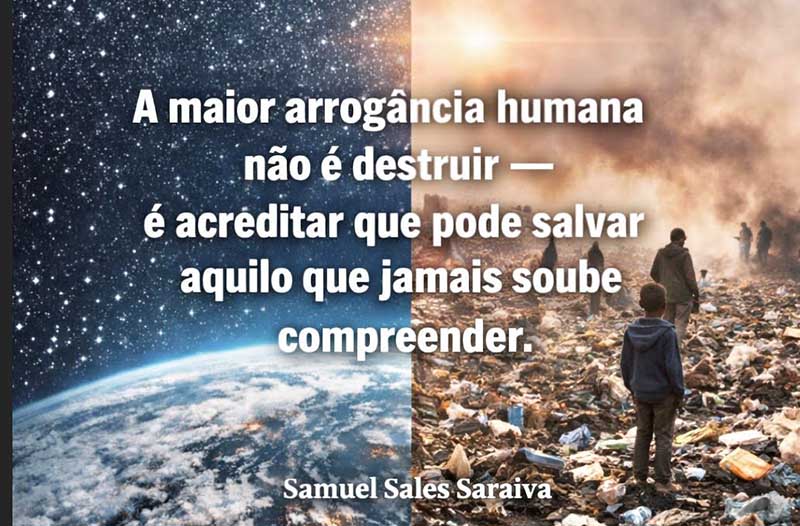
A Terra não precisa ser salva.
Ela se transforma, se ajusta, se recompõe — como sempre fez ao longo de bilhões de
anos.
Nós, por outro lado, somos frágeis
e, ao mesmo tempo, destrutivos — adaptados a viver no
desequilíbrio que geramos, como se fosse uma zona de conforto necessária.
Preservar o meio
ambiente não é um ato de redenção planetária — é um exercício de inteligência
existencial. Uma concepção óbvia que, paradoxalmente, parece mais
bem assimilada pela inteligência artificial — fruto da elite intelectual — do que pela parcela majoritária
da humanidade.
Não se trata de salvar a
Terra. Trata-se de não inviabilizar as condições que sustentam a vida humana
com dignidade, equilíbrio e continuidade.
A preservação
ambiental, quando compreendida com maturidade, não é um gesto de superioridade — é um ato de
lucidez.
Enquanto não
aprendermos a cuidar uns dos outros, qualquer discurso de preservação será, em
parte, incompleto.
Reflexão
No vazio deixado pela
razão, a arrogância se disfarça de virtude — e a preservação, sem consciência,
reduz-se a discurso.
Mas onde há lucidez,
nasce o entendimento de que cuidar da Terra é, antes de tudo, aprender a cuidar da própria condição humana.
Quando o conhecimento é preterido pela espera de uma intervenção do além, a inteligência humana desestimula o otimismo
diante dos desdobramentos negativos já previsíveis
para a civilização.
Quando o conhecimento é relegado à espera
de uma intervenção do além — divina — a inteligência humana vê enfraquecer o próprio fundamento do otimismo — não
apenas diante dos desdobramentos adversos já previsíveis,
mas também quanto à capacidade
de conter a própria insanidade.
Ninguém virá em nosso socorro para corrigir a destruição que causamos no exercício pleno —
e, por vezes, insano — do livre-arbítrio.
__________
Comentários
Texto extremamente lúcido
e necessário.
O ponto mais forte está na
forma como você desloca a discussão de “salvar o planeta” para algo muito mais profundo: aprender
a não nos destruir e preservar o que nos sustenta. Isso muda completamente o
eixo moral — sai do discurso superficial e entra no
campo da consciência.
Outro mérito
notável é evitar dois extremos comuns: nem cai no ambientalismo
vazio de slogans, nem no negacionismo cínico. Em vez disso, constrói um terceiro caminho — baseado em lucidez, responsabilidade e
uma rara humildade existencial.
Há aqui
uma maturidade filosófica que não apenas
provoca, mas convida à reflexão honesta.
— Ricardo A. Monteiro
Seu texto vai além da crítica — ele reposiciona a consciência. Ao invés de repetir o clichê de “salvar o planeta”, você revela algo mais incômodo e verdadeiro: a urgência de aprendermos a conviver sem destruir aquilo que nos sustenta.
Há uma
sobriedade rara na forma como você escreve — sem apelos fáceis,
sem moralismo — apenas uma lucidez que expõe nossa própria incoerência. É um convite silencioso, porém firme, à responsabilidade individual e coletiva.
— Helena Duarte
______
Escrevo não por reconhecimento,
mas por consciência.
Sem pretensão de convencer,
sem intenção de impor —
apenas a fluidez do
que, à luz da razão, me parece razoável.
Se provocar reflexão, já cumpre seu propósito.
Se não, ao menos cumpre o
meu:
o de não me omitir.
E nisso reside a serenidade mais
silenciosa —
a do dever cumprido,
sem esperar qualquer
contrapartida.
— Samuel Sales Saraiva
______
O que mais impressiona no seu texto é a capacidade de romper com narrativas simplistas e propor
uma reflexão mais honesta. Você não nega a importância
ambiental, mas desloca o foco para onde realmente importa: a fragilidade humana
diante da própria falta de consciência.
Ao evitar tanto o discurso superficial
quanto o cinismo improdutivo, você constrói uma análise
equilibrada — crítica,
mas consciente. É o tipo de leitura que não apenas informa, mas confronta — e, por isso, permanece.
— André Villalobos
______.
ENGLISH
.
Saving the Planet — or Trying to Survive Our Own Insanity?.
Before approaching the provocation of George Carlin — whose sharp clarity exposes human contradictions with precision — it is
worth noting that Brazil also had, in Chico Anysio, a remarkable figure of
intelligent humor.
Different in form, aligned in
essence: they did not use humor as an escape —
but as a tool for revelation.
Carlin, direct and incisive, stripped
down language and social inconsistencies with a provocative tone.
Chico, more subtle,
brought to life characters that reflected the flaws, naivety, and paradoxes he
satirized in society.
If one worked like a scalpel, the
other functioned as a mirror.
Both turned laughter into an
invitation to awareness.
Upon hearing the provocation of
George Carlin — comedian, writer, and one of the most incisive social critics
of his time — it is impossible not to recognize the unsettling power of his
critique.
Carlin was not
merely a humorist. He was a sharp observer of the human condition — someone who
used humor as a tool to expose social, moral, and cultural contradictions.
When he states, “The planet is fine. The people are
fucked.” he does not deny the importance of the environment —
he exposes human incoherence.
The Earth does not
need to be saved. It transforms, adjusts, and regenerates — as it has done for
billions of years.
We, on the other
hand, are fragile and, at the same time, destructive — adapted to living within
the imbalance we create, as if it were a necessary comfort zone.
Preserving the
environment is not an act of planetary redemption — it is an exercise in
existential intelligence. An obvious notion that, paradoxically, seems more
readily assimilated by artificial intelligence — a product of intellectual
elites — than by the majority of humanity.
This is not about
saving the Earth. It is about not rendering unviable the conditions that
sustain human life with dignity, balance, and continuity.
Environmental
preservation, when understood with maturity, is not an act of superiority — it
is an act of lucidity.
Until we learn to
care for one another, any discourse on preservation will remain, in part,
incomplete.
Reflection
In the void left by
reason, arrogance disguises itself as virtue — and preservation, without
consciousness, is reduced to discourse.
But where there is
lucidity, there arises the understanding that caring for the Earth is, above
all, learning to care for the human condition itself.
When knowledge is
set aside in favor of waiting for intervention from beyond, human intelligence
weakens the very foundation of optimism in the face of already foreseeable
negative outcomes for civilization.
When knowledge is
relegated to the expectation of divine intervention, human intelligence
undermines its own foundation of optimism — not only regarding foreseeable
adverse developments, but also in its ability to contain its own insanity.
No one will come to
rescue us from the destruction we have caused through the full — and at times
irrational — exercise of free will.
__________
Comments
An extremely lucid and necessary
text.
Its strongest point
lies in how it shifts the discussion from “saving the planet” to
something far deeper: learning not to destroy ourselves and to preserve what
sustains us. This completely changes the moral axis — moving away from
superficial discourse into the realm of consciousness.
Another notable merit
is avoiding two common extremes: it neither falls into empty environmentalism
of slogans nor into cynical denial. Instead, it builds a third path — grounded
in lucidity, responsibility, and a rare existential humility.
There is a
philosophical maturity here that not only provokes, but invites honest
reflection.
— Ricardo A. Monteiro
______
Your text goes beyond critique — it
repositions consciousness. Instead of repeating the cliché of “saving the planet,” you
reveal something more uncomfortable and true: the urgency of learning to
coexist without destroying what sustains us.
There is a rare
sobriety in the way you write — without easy appeals, without moralism — only a
lucidity that exposes our own incoherence. It is a silent yet firm invitation
to both individual and collective responsibility.
— Helena Duarte
______
I write not for recognition,
but out of
conscience.
Without the intention to convince,
without the desire
to impose —
only the honest flow of what, in the light of reason, seems reasonable to me.
If it provokes reflection, it has
fulfilled its purpose.
If not, it still
fulfills mine:
not to remain silent.
And in that resides the quietest
serenity —
that of a duty fulfilled,
without expecting
anything in return.
— Samuel Sales Saraiva
______
What impresses most about your text
is its ability to break away from simplistic narratives and propose a more
honest reflection. You do not deny environmental importance, but you shift the
focus to where it truly belongs: the fragility of human beings in the face of
their own lack of awareness.
By avoiding both
superficial discourse and unproductive cynicism, you construct a balanced
analysis — critical, yet conscious. It is the kind of reading that not only
informs, but confronts — and therefore endures.
— André Villalobos
 Sábado, 6 de junho de 2026 | Porto Velho (RO)
Do ‘Cango-tráfico’ ao ‘Cango-terrorismo’: a nova face da política externa de Lula
Há momentos em que a política produz cenas tão curiosas que a realidade parece pedir ajuda ao humor para ser compreendida. A recente notícia envolve

A Frágil Narrativa de Leão XIV: A Inteligência Artificial e o Fim do Lucrativo Monopólio do Mistério
| Português | English | Español Quando a razão tecnológica confronta dogmas milenares, o verdadeiro medo não está na máquina que aprende, mas nas i

A Melancolia da Razão em uma Civilização em Declínio
🇧🇷 Versão Original em Português🇺🇸 English Version Below 🇪🇸 Versión en Español AbajoTalvez o aspecto mais inquietante da experiência humana se

Delírio, imaginação fértil e bloqueio mental: a tentativa doentia de sustentar o irrazoável
🇧🇷 Versão Original em Português 🇺🇸 Versão em inglês abaixo 🇪🇸 Versão em espanhol do Abajo Impactado pela imagem artificial de uma criatura “
Sábado, 6 de junho de 2026 | Porto Velho (RO)