
Sábado, 6 de junho de 2026 | Porto Velho (RO)
Sábado, 6 de junho de 2026 | Porto Velho (RO)

Segunda-feira, 6 de abril de 2026 - 16h05
ENGLISH
VERSION ATTACHED
Leis naturais
não podem ser atropeladas pela insanidade humana
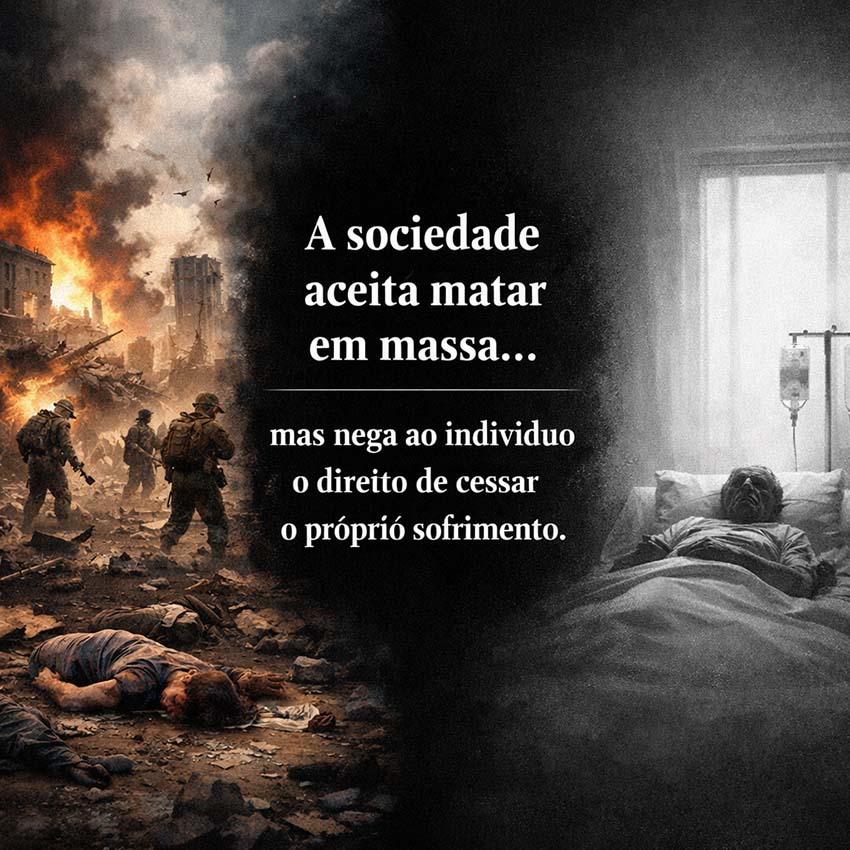
Sociedades resolvem seus conflitos com guerras, matando inclusive civis
inocentes, o que evidencia a ausência de legitimidade moral para proibir a eutanásia e condenar
doentes terminais ao sofrimento injustificável e desumano.
Nenhuma lei
humana pode se firmar acima do direito natural. Portanto, proibir a eutanásia, além de
desrespeitar esse direito, constitui um ato hipócrita,
injusto e, sobretudo, carente de moral e legitimidade.
Evocar o direito
de matar em nome de um Deus que se afirma ser amor é, no mínimo, um
paradoxo. Mais ainda: é uma incoerência impor leis em seu nome para justificar a
imposição cruel, desumana e indecente àqueles que
imploram por abrir mão de uma realidade que já não significa
viver — mas apenas existir, condenados à dor.
A ignorância crônica, o
fanatismo religioso e a distorção da razão por narrativas baseadas
exclusivamente na fé constituem uma agressão aos postulados morais e éticos que
deveriam orientar uma consciência civilizacional.
A fé, enquanto
expressão individual, é um direito. Mas não pode servir de amparo legal ou moral
para se sobrepor ao direito natural alheio — sob pena
de perder validade prática e legitimidade racional.
“A garantia do livre-arbítrio cessa na
linha divisória do direito alheio.”
E aqui reside uma questão incontornável: se nem a um
animal negamos o direito a uma morte assistida — amparada
por critérios objetivos
e compassivos —, por que o negamos ao ser humano?
Fundamentos já aceitos — quando
se trata de animais
1.
Moral
Evitar sofrimento extremo e irreversível
Princípio da
compaixão acima da prolongação da dor
Responsabilidade ética em proteger o bem-estar
2.
Humanitário
Garantia de morte sem dor (procedimento controlado e indolor)
Indicação em casos de doença terminal ou dor intratável
Reconhecimento por entidades como a American Veterinary Medical Association
como prática ética quando
justificada
3.
Mental / Psicológico
Redução do sofrimento emocional ao evitar testemunhar dor
contínua
Processo de luto mais consciente e compassivo
Decisão baseada no cuidado, não na negligência
4.
Espiritual
Ato de misericórdia e libertação do
sofrimento
Respeito ao ciclo natural da vida quando não há possibilidade de
recuperação
Compreensão do desapego como forma de amor
5.
Profissional / Técnico
Avaliação e recomendação por médico veterinário
Protocolos seguros de sedação e indução
Decisão orientada pelo bem-estar como prioridade
Então, por
que negar isso aos humanos?
Seres que, além da prerrogativa do livre-arbítrio, sentem
dor, sofrem, compreendem sua condição e percebem a perda total de qualidade de
vida?
Por que
condená-los a
um sofrimento prolongado — compartilhado,
inclusive, por aqueles que, por amor, compaixão ou gratidão, acompanham o
moribundo até um
desfecho incerto?
Livre-arbítrio: conceito
amplamente reconhecido
Livre-arbítrio é a capacidade de
escolha autônoma
realizada pela vontade humana.
É o direito de decidir, com base em valores, crenças, consciência e percepção da
realidade.
Esse conceito
está diretamente
ligado ao direito de escolha.
As ações decorrentes dessa escolha pertencem ao indivíduo e à sua vontade
consciente.
Historicamente,
o livre-arbítrio
ocupa posição central na filosofia, na ciência e na
religião, com implicações morais, psicológicas e
sociais profundas.
Ainda assim,
justamente no momento em que sua aplicação se torna mais relevante — diante
do sofrimento irreversível — ele é negado.
Responsabilidade
moral e visão científica
A
responsabilidade moral pressupõe continuidade da identidade humana ao longo da
vida, independentemente das transformações físicas e mentais.
Já a ciência, em
diversos momentos, tratou o universo sob uma ótica
determinista, levantando dúvidas sobre a própria
existência do
livre-arbítrio.
Ainda assim,
mesmo sob questionamento filosófico, a experiência humana da
escolha permanece como base das decisões individuais.
O paradoxo
religioso
Segundo muitas
correntes religiosas, o livre-arbítrio seria um dom concedido por Deus — a
capacidade de escolher entre o bem e o mal.
Mas essa ideia
levanta questionamentos inevitáveis:
Se o livre-arbítrio foi
concedido, por que limitar sua aplicação?
Se Deus é onisciente,
teria previsto as consequências?
Se criou tudo, inclusive o mal, qual é a responsabilidade atribuída à criação e qual
ao criador?
Se
hipoteticamente o criador anteviu um mundo marcado por sofrimento, violência, destruição e
contradições morais, surge uma indagação inevitável:
onde reside a
responsabilidade última?
O homem que
sofre?
Ou o sistema que o condiciona?
A incoerência moral da
proibição
Proibir a eutanásia, ao final,
revela-se uma forma de crueldade institucionalizada.
É o atropelo do
livre-arbítrio.
É a condenação de um inocente ao sofrimento evitável.
É a imposição de dor sob justificativas que não se sustentam à luz da razão.
Se Deus é amor, e
sofrimento implica ausência desse amor, por que impor sofrimento àquele que
deseja, de forma lúcida,
se libertar dele?
Isso contraria a
lógica, agride a razão e revela um apego a dogmas que
coexistem, de forma contraditória, com os
benefícios da
ciência
— a mesma ciência que prolonga a vida, mas que, ironicamente,
não pode permitir que ela termine com dignidade.
Reflexão final
Livre-arbítrio desprovido
de discernimento — ou impedido de ser exercido — é como um
carro de alta performance sem freios.
Em algum
momento, a consequência
será inevitavelmente
trágica.
Se há liberdade, ela
deve ser acompanhada de responsabilidade e consciência.
Se há sofrimento
irreversível,
deve haver, ao menos, o direito de não prolongá-lo.
Negar isso não é proteção.
É imposição.
Conclusão
Aceitam — e muitas
vezes legitimam — a morte em massa, inclusive de
inocentes.
Mas,
paradoxalmente, impedem o fim do sofrimento daquele que, de forma lúcida, deseja
apenas se libertar da dor.
E, ainda assim,
afirmam: “a vida
pertence a Deus, e só Ele pode tirá-la” — numa
interpretação conveniente, seletiva e profundamente distorcida.
Porque, na prática, a vida é tirada todos os
dias pelos próprios homens, em diferentes contextos — guerras,
conflitos, violência
— muitas vezes sem o menor constrangimento, sem reflexão,
sem piedade.
Essa contradição não é apenas incoerência.
Ela revela algo mais profundo:
a mesma natureza
humana que se destrói em guerras
é aquela que, sob justificativas morais frágeis, impõe
sofrimento a um moribundo.
Há, nisso, uma
convergência
inquietante —
não de
valores elevados, mas da expressão mais crua da incoerência humana.
Negar a alguém o direito de
decidir sobre o próprio fim, quando já não
há vida
digna a ser vivida,
não é proteção.
É imposição.
É prolongamento deliberado da dor.
E, em última instância, é uma forma
silenciosa de crueldade —
praticada contra alguém que já não tem sequer forças para se
defender.
______
ENGLISH
Free Will
Legitimizes Euthanasia
Natural laws
cannot be overridden by human insanity.
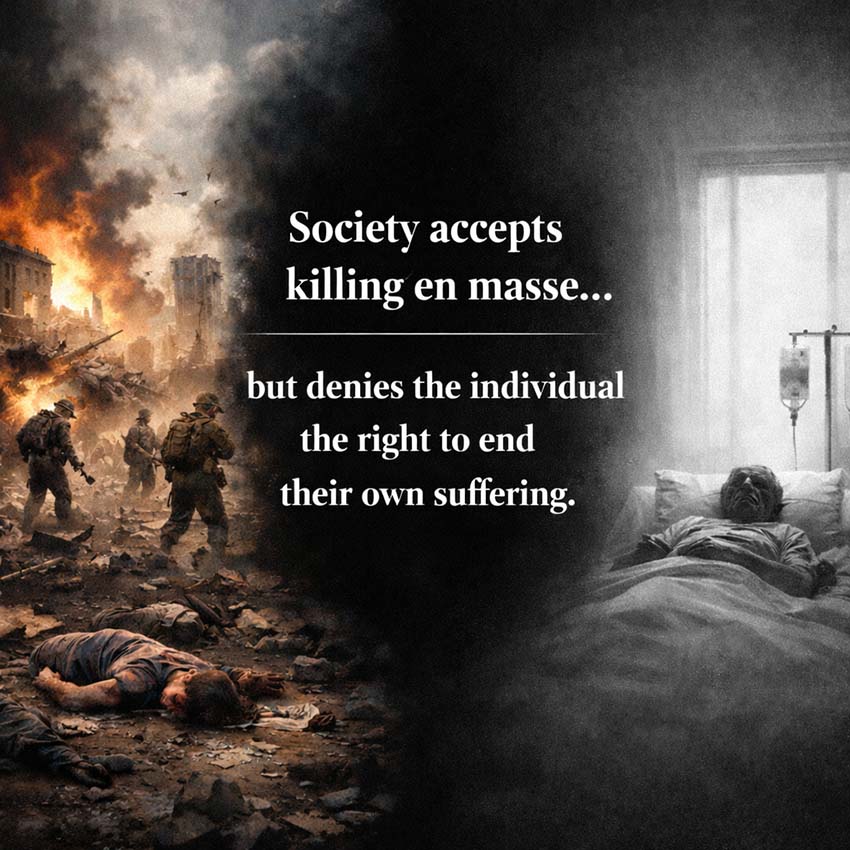
Societies
resolve their conflicts through wars, killing even innocent civilians, which
reveals the absence of moral legitimacy to prohibit euthanasia and condemn
terminally ill patients to unjustifiable and inhumane suffering.
No human law
can stand above natural rights. Therefore, prohibiting euthanasia, beyond
disrespecting this right, constitutes a hypocritical, unjust act, lacking moral
and rational legitimacy.
Invoking the
right to kill in the name of a God said to be love is, at the very least,
paradoxical. Even more so: it is inconsistent to impose laws in His name to
justify the cruel, inhumane, and indecent imposition on those who plead to
relinquish a reality that no longer represents living — but merely existing,
condemned to pain.
Chronic
ignorance, religious fanaticism, and the distortion of reason through
narratives based exclusively on faith constitute an aggression against the
moral and ethical principles that should guide a civilized consciousness.
Faith, as an
individual expression, is a right. But it cannot serve as legal or moral
grounds to override another’s
natural rights — under penalty of losing practical validity and rational
legitimacy.
“Free will ends at the boundary of another’s rights.”
And here lies
an unavoidable question: if we do not deny animals the right to assisted death
— supported by objective and compassionate criteria — why do we deny it to human
beings?
Foundations
already accepted — when it comes to animals
Moral
•
Avoidance of extreme and irreversible
suffering
•
Principle of compassion above
prolonging pain
•
Ethical responsibility to protect
well-being
Humanitarian
•
Guarantee of a painless death
(controlled and humane procedure)
•
Indicated in cases of terminal
illness or untreatable pain
•
Recognized by entities such as the
American Veterinary Medical Association as an ethical practice when justified
Mental /
Psychological
•
Reduction of emotional suffering by
avoiding witnessing ongoing pain
•
A more conscious and compassionate
grieving process
•
Decisions based on care, not neglect
Spiritual
•
An act of mercy and liberation from
suffering
•
Respect for the natural cycle of life
when recovery is no longer possible
•
Understanding detachment as a form of
love
Professional
/ Technical
•
Evaluation and recommendation by a
veterinarian
•
Safe sedation and induction protocols
•
Decisions guided by well-being as the
primary priority
So why deny
this to humans?
Beings who,
in addition to free will, feel pain, suffer, understand their condition, and
perceive the total loss of quality of life?
Why condemn
them to prolonged suffering — shared even by those who, out of love,
compassion, or gratitude, accompany the dying toward an uncertain end?
Free will: a
widely recognized concept
Free will is
the capacity for autonomous choice exercised through human will.
It is the right to decide based on values, beliefs, consciousness, and
perception of reality.
This concept
is directly linked to the right of choice.
The actions resulting from this choice belong to the individual and
their conscious will.
Historically,
free will holds a central place in philosophy, science, and religion, with deep
moral, psychological, and social implications.
Yet,
precisely at the moment when its application becomes most relevant — in the
face of irreversible suffering — it is denied.
Moral
responsibility and scientific perspective
Moral
responsibility presupposes continuity of human identity throughout life,
regardless of physical and mental transformations.
Science, at
various times, has approached the universe through a deterministic lens,
raising doubts about the very existence of free will.
Even so,
despite philosophical questioning, the human experience of choice remains the
foundation of individual decisions.
The religious
paradox
According to
many religious traditions, free will is a gift granted by God — the ability to
choose between good and evil.
But this idea
raises unavoidable questions:
If free will
was granted, why limit its application?
If God is omniscient, did He foresee the consequences?
If He created everything, including evil, where does responsibility lie
— with creation or the creator?
If,
hypothetically, the creator foresaw a world marked by suffering, violence,
destruction, and moral contradictions, an inevitable question arises:
Where does
ultimate responsibility reside?
In the
suffering individual?
Or in the system that conditions him?
The moral
incoherence of prohibition
Prohibiting
euthanasia ultimately reveals itself as a form of institutionalized cruelty.
It is the
suppression of free will.
It is the condemnation of an innocent person to avoidable suffering.
It is the imposition of pain under justifications that do not withstand
rational scrutiny.
If God is
love, and suffering implies the absence of that love, why impose suffering on
someone who, in full awareness, seeks to be free from it?
This
contradicts logic, offends reason, and reveals an attachment to dogmas that
coexist, paradoxically, with the benefits of science — the same science that
prolongs life, but ironically cannot allow it to end with dignity.
Final
reflection
Free will
deprived of discernment — or prevented from being exercised — is like a high-performance
car without brakes.
At some
point, the consequence will inevitably be tragic.
If there is
freedom, it must be accompanied by responsibility and awareness.
If there is irreversible suffering, there must at least be the right not
to prolong it.
Denying this
is not protection.
It is imposition.
Closing
They promote
wars.
They accept — and often legitimize — mass death, including that of
innocents.
Yet,
paradoxically, they prevent the end of the suffering of someone who, in full
awareness, simply wishes to be free from pain.
And still,
they claim: “life
belongs to God, and only He can take it” — a convenient, selective, and deeply
distorted interpretation.
Because, in
practice, life is taken every day by human beings themselves, in different
contexts — wars, conflicts, violence — often without hesitation, without
reflection, without compassion.
This
contradiction is not merely inconsistency.
It reveals something deeper:
the same
human nature that destroys itself in wars
is the one that, under fragile moral justifications, imposes suffering
on the dying.
There is, in
this, a disturbing convergence —
not of elevated values, but of the rawest expression of human inconsistency.
To deny
someone the right to decide their own end, when no dignified life remains to be
lived,
is not protection.
It is
imposition.
It is the deliberate prolongation of pain.
And,
ultimately, it is a silent form of cruelty —
inflicted upon someone who no longer even has the strength to defend
themselves.
______
 Sábado, 6 de junho de 2026 | Porto Velho (RO)
Do ‘Cango-tráfico’ ao ‘Cango-terrorismo’: a nova face da política externa de Lula
Há momentos em que a política produz cenas tão curiosas que a realidade parece pedir ajuda ao humor para ser compreendida. A recente notícia envolve

A Frágil Narrativa de Leão XIV: A Inteligência Artificial e o Fim do Lucrativo Monopólio do Mistério
| Português | English | Español Quando a razão tecnológica confronta dogmas milenares, o verdadeiro medo não está na máquina que aprende, mas nas i

A Melancolia da Razão em uma Civilização em Declínio
🇧🇷 Versão Original em Português🇺🇸 English Version Below 🇪🇸 Versión en Español AbajoTalvez o aspecto mais inquietante da experiência humana se

Delírio, imaginação fértil e bloqueio mental: a tentativa doentia de sustentar o irrazoável
🇧🇷 Versão Original em Português 🇺🇸 Versão em inglês abaixo 🇪🇸 Versão em espanhol do Abajo Impactado pela imagem artificial de uma criatura “
Sábado, 6 de junho de 2026 | Porto Velho (RO)